
When anglers think about fly fishing Bariloche, they often picture the spectacular lakes and rivers of northern Patagonia: clear mountain water, dramatic Andean scenery, and wild trout in an unforgettable landscape. But just beyond the city, one of the region’s most exciting fisheries begins at the outlet of Lake Nahuel Huapi.
The Limay River offers something very different from many of the smaller rivers around Bariloche. It is a large, powerful river with deep pools, strong runs, rocky banks, islands, and long stretches of open water. And beneath that clear current lives one of Patagonia’s most fascinating trout: the migratory brown trout.
For us at Trout Bariloche, the Limay is one of the rivers we know best. It is a river where the fishing can change from one day to the next and where a day of casting can become a search for one extraordinary fish.
That is part of what makes fly fishing in Bariloche so special. You are not simply visiting a beautiful destination and catching trout. You are entering a river system where resident trout and powerful migratory fish create very different fishing opportunities throughout the season.
Fly Fishing Bariloche: Why the Limay River Is a Top Destination
The Limay River begins at Lake Nahuel Huapi, near Bariloche, and flows eastward from the Andes toward the Patagonian steppe. As the river leaves the forested environment around the lake, the landscape gradually opens into the characteristic dry scenery of northern Patagonia.
The contrast is remarkable.
Willow-lined riverbanks can appear against an otherwise open and rugged landscape. Deep pools transition into fast runs and shallow riffles. Islands divide the current into different channels, while drop-offs, submerged structure, rocky edges, and current seams create holding water for trout.
For an angler planning a fly fishing trip to Bariloche, this variety is important.
The Limay is not a river where a single technique or type of water defines the entire experience. Some days may be dedicated to searching for large trout with streamers. On others, resident browns and rainbows can respond to nymphs, dry flies, or terrestrial patterns.
The river rewards anglers who pay attention to current, water conditions, weather, trout behavior, and the food available in the system.
That is why we do not approach every Limay fishing day in exactly the same way.
We read the river first and adapt our fishing to what it gives us.
The Limay River Near Bariloche
For anglers staying in Bariloche, the upper section of the Limay is particularly attractive because of its proximity to the city and its connection to Lake Nahuel Huapi.
The river begins at the lake outlet, an area commonly known as La Boca, and continues through the first section of the Limay before entering the wider Patagonian steppe.
This connection between lake and river is one of the most important characteristics of the fishery.
The Limay is home to resident brown and rainbow trout, but its connection to Lake Nahuel Huapi also makes it possible to encounter large migratory brown trout moving between the lake and the river during their seasonal migrations.
For a fly angler, this changes the way you look at the water.
A deep pool is no longer simply a deep pool. A strong current seam is not just another piece of moving water. Every likely holding area can become part of the search for a fish that may have spent part of its life in the lake before entering the river.
This is one of the reasons we particularly enjoy fishing the Limay.
The scenery is spectacular, but the uncertainty of what might be holding in the next pool is what keeps us focused.
Patagonia’s Migratory Brown Trout
The migratory brown trout are one of the main reasons serious anglers travel to northern Patagonia.
These fish are different from the resident trout that spend their lives in the river. Their seasonal movements between Lake Nahuel Huapi and the Limay can bring powerful fish into the river, creating opportunities for anglers specifically interested in large brown trout.
They are strong fish, and the river gives them plenty of current in which to use that strength.
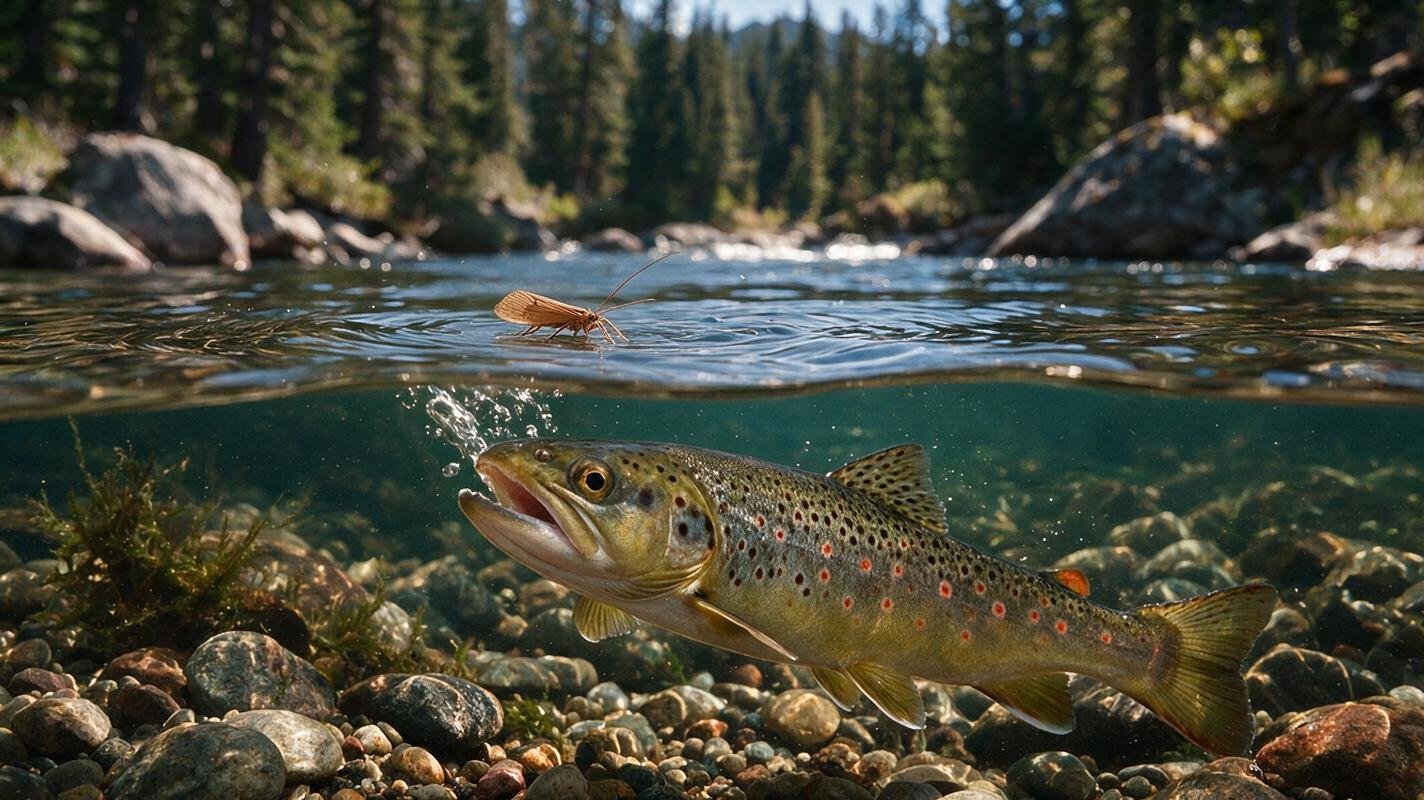
A large migratory brown can turn a routine fishing day into something completely different. A fly can be followed for several meters before the fish commits. The take can be explosive, and once the fish turns downstream, the river’s strength becomes part of the fight.
Some of the largest browns can be measured in pounds rather than inches.
That possibility is one of the great attractions of Limay River fly fishing.
But we also believe it is important to understand that the Limay is not only about trophy fish.
Resident brown and rainbow trout provide additional opportunities throughout the season, and the river can offer very different types of fishing depending on conditions.
The attraction is not simply the possibility of catching a giant brown.
It is the possibility that at any moment, the river can give you something you were not expecting.
The Upper Limay: From Lake Nahuel Huapi to the Patagonian Steppe

The Upper Limay has a character of its own.
Close to Lake Nahuel Huapi, the river retains a stronger connection to the Andean environment. As you move farther downstream, the landscape becomes increasingly open and characteristic of the Patagonian steppe.
For the angler, the river itself is constantly changing.
Deep pools can hold trout resting out of the strongest current. Runs provide feeding lanes and seams. Shallow riffles can become productive when trout are actively feeding, while islands create multiple channels that require careful reading.
The clarity of the water can make presentation especially important.
On a clear river, trout can have plenty of time to inspect a fly. Accuracy, fly selection, leader presentation, and the angle from which the water is approached all matter.
The Limay is therefore not simply a casting exercise.
Successful fishing often begins before the fly touches the water.
You need to understand how the current is moving, where the trout can hold with minimum effort, where food is likely to travel, and how your fly will move once it enters the current.
That river reading is one of the most valuable skills we try to share with visiting anglers.
Brown and Rainbow Trout of the Limay River
Although migratory brown trout receive much of the attention, the Limay supports a diverse trout fishery.
Resident brown trout can provide exciting fishing throughout the season, while rainbow trout add another dimension to the experience.
This variety is one of the reasons the Limay can work for anglers with different goals.
An angler focused exclusively on trophy browns may want to spend hours covering water with large streamers. Another angler may prefer technical dry-fly fishing for resident trout. A third may enjoy changing techniques throughout the day.
The river can accommodate all of these approaches.
At Trout Bariloche, we prefer to let the river determine the strategy rather than forcing every day into a predetermined plan.
If conditions favor streamers, we fish streamers.
If trout are feeding on insects near the surface, we adapt.
If nymphing becomes the most productive option, we change the setup.
The goal is not to fish one particular method. The goal is to give the angler the best possible opportunity under the conditions we actually find on the river.
When Is the Best Time for Fly Fishing in Bariloche?
There is no single month that can be described as the perfect time for every type of Limay fishing.
The character of the fishing changes throughout the trout season, and the best period depends heavily on what you want to experience.
Start of the Fly-Fishing Season on the Limay River
The early season can provide opportunities for migratory fish entering the river from Lake Nahuel Huapi, as well as for resident trout.
For anglers interested in larger fish, this period can be particularly appealing because seasonal movements can bring migratory browns into the river system.
The exact fishing experience depends on water conditions, weather, river levels, and trout behavior.
Summer Fishing in Bariloche
Summer can provide more consistent opportunities for resident brown and rainbow trout.
Dry-fly and nymphing opportunities can become an important part of the fishing, particularly when trout are actively feeding on aquatic insects and terrestrial food sources.
For anglers looking for variety rather than exclusively targeting large migratory browns, summer can be an excellent time to experience the Limay.
Fall Fly Fishing in Bariloche and the Brown Trout Run
Late season is one of the most exciting periods for anglers specifically interested in large migratory brown trout.
As the season progresses, the movement of larger fish becomes increasingly important to the fishing strategy.
This is when the Limay can become a true hunting river.
You may cover a significant amount of water without a major response. Then a large brown appears behind a streamer, follows the fly, and suddenly commits.
One cast can change the entire day.
That uncertainty is not a disadvantage.
It is one of the reasons we keep coming back.
How We Fish the Limay River
There is no universal Limay River fly fishing technique.
We may use large streamers, sinking shooting heads, floating lines, nymphs, large attractor dry flies, terrestrial patterns, or dry-dropper combinations depending on the conditions.
Streamer Fishing for Large Brown Trout in Bariloche
Streamer fishing is particularly exciting when the objective is to find a large migratory brown.
The idea is not simply to throw a large fly and hope.
Presentation matters.
The streamer needs to move through the right water, at the right depth and speed, while allowing the trout an opportunity to see and follow it.
A well-presented streamer moving across a productive current seam can produce a violent take.
Sometimes the fish commits immediately.
Other times, a brown may follow the fly for several meters before turning away. Those moments are part of what makes hunting large trout with streamers so addictive.
Nymphing and Dry-Fly Fishing on the Limay River
Not every Limay day is about throwing large streamers.
Resident trout can provide excellent opportunities with nymphs and dry flies, particularly when insect activity increases.
A dry fly can also become an effective tool when trout are actively feeding near the surface.
The ability to change techniques is essential.
One of the advantages of fishing with a local guide is having someone who can recognize when the river is telling you to stop doing what worked an hour earlier.
Flies, Páncora and the Limay River Food Chain
Understanding what trout eat is a fundamental part of successful fly fishing.
The Limay offers trout a varied food supply that can include aquatic insects, terrestrial insects, crustaceans, baitfish, and other available prey.
The páncora, a freshwater crustacean found in Patagonia, is particularly interesting when targeting larger trout.
These protein-rich food sources can attract larger fish, which is one reason páncora imitations can be an important part of a Limay fly box.
Aquatic insects also play an important role.
Caddis activity, for example, can create aggressive feeding behavior when pupae move toward the surface. Patagonia Trout & Fly has also developed practical material about caddis behavior, fly patterns, and rigs for anglers who want to understand this type of fishing in greater detail.
If you are preparing your fly box for a Patagonia fishing trip, visit Patagonia Trout & Fly for more information about fly patterns, local flies, rigs, and fly-fishing techniques for the rivers around Bariloche.
The important lesson is that flies should not be selected simply because they look attractive in a fly box.
They should make sense of what trout are actually eating and how those food sources move through the river.
What Is a Day of Fly Fishing Bariloche Like?
A typical Limay fishing day begins with pickup at your hotel in Bariloche and a drive toward the river.
Once we arrive, the day develops according to the conditions.
Some days are about covering water and searching for a large migratory brown with streamers.
Other days involve carefully working productive runs, fishing dry flies to resident trout, or combining techniques throughout the day.
The Limay is large enough that no two days feel exactly the same.
And that uncertainty is part of the attraction.
You may make hundreds of casts without seeing the fish you are looking for.
Then, suddenly, a large brown appears behind the fly.
The fish follows.
You change the angle.
The streamer moves through the seam.
And the brown commits.
That is Limay fishing.
It is not always about numbers. Sometimes the entire day is built around the possibility of one extraordinary fish.
Fishing the Limay River with Trout Bariloche

At Trout Bariloche, our approach is based on local knowledge and adapting the fishing to the river.
We know the rivers around Bariloche and understand that conditions can change throughout the season. That knowledge helps us decide where to fish, how to approach different sections, and which techniques make the most sense on a particular day.
For visiting anglers, the experience is also about making the logistics easier.
We can help with transportation, equipment recommendations, flies, and the daily fishing arrangements so you can concentrate on what brought you to Patagonia in the first place: fishing.
Our service includes equipment, allowing you to focus on fishing rather than traveling with every piece of gear required for a day on the river.
And once we are on the Limay, the objective is simple:
Put you in the best possible position to catch the trout you traveled to Patagonia to find.
Planning Your Bariloche Fly Fishing Trip
Planning a fly-fishing trip to Bariloche is not just about choosing a date.
The type of fishing you want to experience should influence when you travel, which river you fish, and the techniques you prepare for.
If your priority is a large migratory brown trout, the fish’s seasonal movements should be a major consideration.
If you prefer a combination of resident trout, dry flies, nymphing, and different techniques, other periods may offer a broader range of opportunities.
The advantage of working with a local guide is that you do not have to arrive with every decision already made.
We can adapt the day to the river.
That flexibility is particularly valuable in Patagonia, where wind, weather, water conditions, insect activity, and trout behavior can all influence the fishing.
The Limay is a river that rewards preparation, but it also rewards adaptability.
Why Fish the Limay River with Trout Bariloche?
There are many beautiful rivers in Patagonia.
The Limay is different.
It combines enormous water, clear currents, open Patagonian landscapes, resident brown and rainbow trout, and the possibility of encountering a migratory brown that can make an entire trip unforgettable.
For an angler searching for fly fishing in Bariloche, the Limay offers an experience that is both accessible from the city and genuinely wild once you reach the river.
You can spend the morning reading current seams and searching for a large brown, stop for lunch beside the river, and spend the afternoon covering new water.
The scenery is extraordinary.
The fishing is unpredictable.
And that is exactly the point.
A day on the Limay can involve hundreds of casts without a significant response.
Then the next cast can change everything.
That is why we keep coming back to the river.
And that is why we believe the Limay should be part of any serious angler’s Bariloche fly fishing experience.
Frequently Asked Questions About Fly Fishing Bariloche
Can you fly fish the Limay River from Bariloche?
Yes. The Limay River is one of the key fishing destinations accessible from Bariloche. The upper section begins at the outlet of Lake Nahuel Huapi and provides opportunities for resident trout as well as migratory brown trout.
What trout can you catch in the Limay River?
The Limay supports brown and rainbow trout. Resident fish provide opportunities throughout the season, while migratory brown trout are one of the main attractions for anglers targeting larger fish.
What is the best time for fly fishing Bariloche?
The best period depends on the type of fishing you want. Different parts of the season offer different opportunities, from resident trout and dry-fly fishing to periods when migratory brown trout become the primary target.
What flies should I bring for the Limay River?
The fly selection depends on the season and current conditions. A Limay fly box may include streamers, nymphs, dry flies, terrestrial patterns, and páncora imitations. Local conditions should determine which patterns are most relevant on a particular day.
Is the Limay River good for beginner fly anglers?
The Limay is a large and varied river, so understanding currents, presentation, and casting can be important. Fishing with a local guide can help anglers learn how to read the river and adapt their technique to the conditions.
What makes Limay River brown trout special?
The migratory brown trout of the Limay are powerful fish associated with seasonal movements between Lake Nahuel Huapi and the river. Their size, strength, and unpredictable behavior make them a particularly exciting target for anglers.
One Cast Can Change Your Bariloche Fishing Trip
There are many reasons to go fly fishing in Bariloche.
The scenery is extraordinary. The rivers are diverse. The trout are wild, and the fishing can change dramatically from one day to another.
But the Limay offers something that is difficult to explain until you experience it.
You can spend hours searching.
You can cover pool after pool, seam after seam, wondering whether the next cast will finally produce the fish you came to Patagonia to find.
And then it happens.
A brown appears.
The river suddenly feels different.
One cast becomes the most important cast of the day.
That is the Limay.
And that is why, when anglers ask us about the best fly fishing Bariloche has to offer, the Limay River is always part of the conversation.
Come fish the Limay with Trout Bariloche and experience one of northern Patagonia’s most exciting trout fisheries from a local perspective.